



Compliance with Bilingual Labeling Requirements for Antimicrobial and Non-Agricultural Products with Acute Toxicity Category I Is December 29, 2026
The December 29, 2026,deadline for bilingual labeling compliance for antimicrobial and non-agricultural pesticide products in Acute Toxicity Category I (the highest toxicity category) is fast approaching. The Pesticide Registration Improvement Act of 2022 (PRIA 5), enacted on December 29, 2022, amended the Federal Insecticide, Fungicide, and Rodenticide Act (FIFRA) requiring Spanish language translation for the health and safety sections of the end-use product (EP) labels released for shipment where translation is available in the U.S. Environmental Protection Agency’s (EPA) Spanish Translation Guide for Pesticide Labeling (Guide).
For EP pesticide labels, the registrant has the option of either including the Spanish language translation on the pesticide product container or providing a link to such translation via scannable technology (e.g., quick-response (QR)) or other electronic methods readily accessible on the product label. There are exceptions for antimicrobial pesticide products and non-agricultural/non-restricted use pesticides (RUP). For these categories, Spanish labeling requirements may be satisfied by providing a link to the safety data sheet (SDS) written in Spanish in lieu of including the Spanish translation or a link to translated sections on pesticide labeling. PRIA 5 does not impose bilingual labeling requirements on manufacturing use products (MUP) or experimental use permits (EUP).
EPA’s Guide is a resource for the translation of the required health and safety sections on pesticide labeling from English to Spanish. The registrant is responsible for ensuring that the Spanish text translation is a true and accurate translation of the English text on the label. EPA encourages use of the language in the Guide to assist with the requirement for Spanish labeling to be true and accurate, however, use of the specific language from the Guide is not required.
Specifically, the Guide has Spanish translations for the following:
- “Keep out of reach of children” (KOOROC);
- RUP Statements;
- Misuse Statements;
- Signal Word;
- First Aid;
- Precautionary Statements;
- Personal Protective Equipment (PPE);
- Engineering Controls;
- Environmental Hazards;
- Physical or Chemical Hazards Language; and
- Storage and Disposal Instructions and Container Handling Statements.
The Guide also provides examples of pesticide product label language for the agricultural use requirements section that includes restricted entry interval information and precautionary statements. PRIA 5 also requires EPA to notify registrants within ten days of updating the Guide.
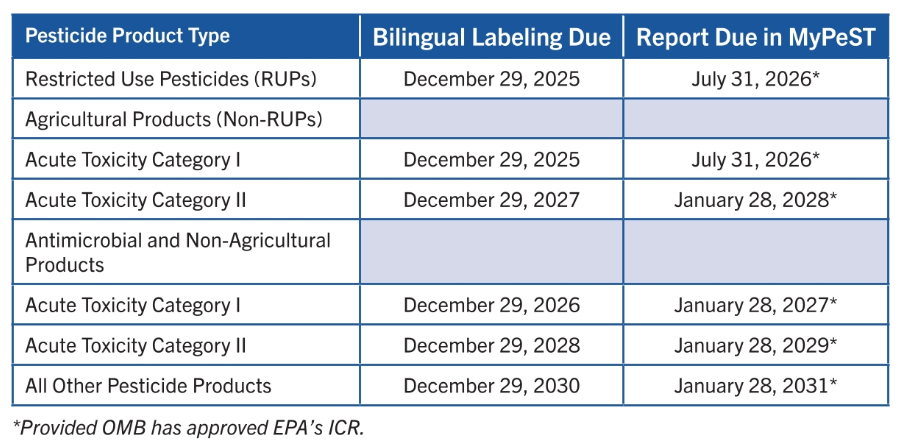
Spanish translations are required on a rolling schedule from December 2025 to December 2030 depending on the type of pesticide product and the toxicity category, with the most hazardous and toxic pesticide products requiring translation first. EP labels on RUP products and agricultural use products with Acute Toxicity Category I were required to bear Spanish language translations by December 29, 2025, and certify bilingual labeling compliance by July 31, 2026. All pesticide labels must have Spanish translations by 2030.
EPA will track adoption of bilingual labeling via MyPeST, EPA’s web-based system for pesticide submissions and tracking. MyPeST displays product information to help registrants determine their products’ bilingual labeling compliance dates to assist the registrant, however, registrants must verify the product information using the EPA-approved product label. Companies will need to check a box in MyPeST next to each of its EPs that includes bilingual labeling. Registrants can check a separate box to indicate for EPs that are subject to bilingual labeling that do not have the bilingual labeling added but will not be released for shipment until the bilingual labeling is added. There is an alternate field to paste the Uniform Resource Locator (URL) for the product’s Spanish labeling or SDS. Bilingual labeling compliance must be reported in MyPeST for antimicrobial and non-agricultural pesticide products in Acute Toxicity Category I on or by January 28, 2027.
FIFRA, as amended by PRIA 5, requires bilingual labeling changes to be implemented through a non-notification procedure (Pesticide Registration (PR) Notice 98-10). The non-notification process means that a product’s labeling may be updated with Spanish translations without notifying EPA or EPA reviewing the updated labeling, if that is the only change being made to the labeling. PRIA 5 specifies that bilingual labeling is implemented via non-notification; thus, EPA will not review Spanish translations. In addition, EPA pointer language text also can be added via non-notification that explains the purpose of the QR code as long as the text only is for the Spanish translation.
If the final printed label does not include the translations by the relevant deadline, the product may be considered misbranded pursuant to FIFRA Section 2(q). EPA enforcement of misbranded pesticides has been trending upwards, with considerable penalties depending on the number of sales or distributions. EPA also has been vigilant in reviewing pesticide labels as part of imported shipments, and if labels do not include required language, EPA could issue a Notice of Recommendation to Refuse Admission (NORRA) that could result in the shipment being exported for the labels to be fixed and then re-imported.
The latest detailed information on EPA’s bilingual pesticide labeling is available on EPA’s website at https://www.epa.gov/pesticide-labels/bilingual-labeling.
Commentary
If your company has any registered antimicrobial or non-agricultural pesticide EP labels with the signal word DANGER (Acute Toxicity Category I), then the deadline for bilingual labeling compliance is on or by December 29, 2026, and bilingual labeling compliance must be reported in MyPeST for these EPs on or by January 28, 2027. If none of your registered products are EPs, then you have no action.
Bilingual translation requirements are ongoing and not just a one-time action. If a registrant updates or revises its English label text for an EP that is required to have bilingual labeling, then the registrant should add the corresponding Spanish translations to their label via non-notification after the English text is approved by EPA.
Also, as the Guide is updated by EPA in the future, the registrant is responsible for ensuring labels incorporate translations for all sections in the updated Guide. For agricultural use pesticide labels, companies must update their product label with the new information within one year after the date of publication of the updated Guide or the latest EPA-approved label, whichever is earlier. For antimicrobial and non-agricultural use pesticide labels, companies must update their product label with the new information within two years after the date of publication of the updated Guide or the latest EPA-approved label, whichever is earlier.
Compliance with EPA’s future requirement for bilingual labeling for antimicrobial and non-agricultural pesticide products in Acute Toxicity Category II is due on December 29, 2028, and January 28, 2029, for compliance reporting in MyPeST.