


The Chair of the New Mexico Environmental Improvement Board (NMEIB) signed a Final Order and Statement of Reasons on April 17, 2026, regarding the adoption of a rule on per- and polyfluoroalkyl substances (PFAS) in consumer products. The final rule, scheduled to be published in New Mexico’s Register on May 5, 2026, with the Final Order and Statement of Reasons, includes prohibitions for certain consumer products in 2027 and 2028; reporting due January 1, 2027; a labeling requirement for products manufactured after January 1, 2027; and a 2032 prohibition on products containing intentionally added PFAS that are not exempt or have a currently unavoidable use (CUU) determination. The final rule will be effective July 1, 2026.
Prohibitions
The product prohibitions in the final rule reflect the statute and are unchanged from the proposed rule. In New Mexico, beginning January 1, 2027, a manufacturer may not sell, offer for sale, distribute, or distribute for sale the following products containing intentionally added PFAS: cookware, food packaging, dental floss, juvenile products, and firefighting foam. Beginning January 1, 2028, a manufacturer may not sell, offer for sale, distribute, or distribute for sale the following products containing intentionally added PFAS: carpets or rugs, cleaning products, cosmetics, fabric treatments, feminine hygiene products, textiles, textile furnishings, ski wax, and upholstered furniture. Beginning January 1, 2032, products containing intentionally added PFAS that are not exempt under New Mexico’s statute will be banned unless the use of the PFAS is determined to be a CUU.
For initial CUU proposals, the requester must submit the required information no later than 12 months prior to the applicable sales prohibition. Under the final rule, complete CUU proposals for prohibitions effective January 1, 2027, that the New Mexico Environment Department (NMED) receives by October 31, 2026, will be considered approved pending review. NMED will issue a final determination of whether to approve or deny those proposals by March 1, 2027.
Exemptions
The final rule includes those in the statute, as well as the proposed rule:
- A product for which federal law governs the presence of a PFAS in the product in a manner that preempts state authority;
- Used products offered for sale or resale;
- Medical devices or drugs and the packaging of the medical devices or drugs that are regulated by the U.S. Food and Drug Administration (FDA), including prosthetic and orthotic devices;
- Cooling, heating, ventilation, air conditioning, or refrigeration equipment that contains intentionally added PFAS or refrigerants listed as acceptable, acceptable subject to use conditions, or acceptable to narrowed use limits by the U.S. Environmental Protection Agency (EPA) pursuant to the Significant New Alternatives Policy (SNAP) Program, and sold, offered for sale, distributed, or distributed for sale for the use for which the refrigerant is listed pursuant to that program;
- A veterinary product and its packaging intended for use in or on animals, including diagnostic equipment or test kits and the veterinary product’s components and any product that is a veterinary medical device, drug, biologic, or parasiticide or that is otherwise used in a veterinary medical setting or in veterinary medical applications that are regulated by or under the jurisdiction of:
- FDA;
- The U.S. Department of Agriculture (USDA) pursuant to the federal Virus-Serum-Toxin Act; or
- EPA pursuant to the Federal Insecticide, Fungicide, and Rodenticide Act (FIFRA), except that any such products approved by EPA pursuant to that law for aerial and land application are not exempt from this section;
- FDA;
- A product developed or manufactured for the purpose of public health or environmental or water quality testing;
- A motor vehicle or motor vehicle equipment regulated under a federal motor vehicle safety standard, except that the exemption does not apply to any textile article or refrigerant that is included in or as a component part of such products;
- Any other motor vehicle, including an off-highway vehicle or a specialty motor vehicle, such as an all-terrain vehicle, a side-by-side vehicle, farm equipment, or a personal assistive mobility device;
- A watercraft, an aircraft, a lighter-than-air aircraft, or a seaplane;
- A semiconductor, including semiconductors incorporated in electronic equipment, and materials used in the manufacture of semiconductors;
- Non-consumer electronics and non-consumer laboratory equipment not ordinarily used for personal, family, or household purposes;
- A product that contains intentionally added PFAS with uses that are currently listed as acceptable, acceptable subject to use conditions, or acceptable subject to narrowed use limits in EPA’s rules under the SNAP Program; provided that the product contains PFAS that are being used as substitutes for ozone-depleting substances under the conditions specified in the rule;
- A product used for the generation, distribution, or storage of electricity;
- Equipment directly used in the manufacture or development of the products listed above;
- A product for which NMEIB has adopted a rule providing that the use of PFAS in that product is a CUU; or
- A product that contains fluoropolymers consisting of polymeric substances for which the backbone of the polymer is either a per- or polyfluorinated carbon-only backbone or a perfluorinated polyether backbone that is a solid at standard temperature and pressure.
The final rule also includes an exemption for:
- A pesticide that is regulated by or under the jurisdiction of FIFRA.
As we reported, NMED revised the proposed rule in January and February 2026, before NMEIB’s administrative rulemaking hearing. The revisions included adding an exemption for pesticides. Exempt products are exempt from both the reporting and prohibition requirements. Only a handful of exempt products are also exempt from the labeling requirement.
Reporting
Under the statute, on or before January 1, 2027, New Mexico will require manufacturers of products containing intentionally added PFAS to report certain information, including:
- A brief description of the product, including a universal product code (UPC), stock keeping unit (SKU), or other numeric code assigned to the product;
- The purpose for which the PFAS is used in the product;
- The amount of each PFAS in the product, identified by its Chemical Abstracts Service Registry Number® (CAS RN®) and reported as an exact quantity determined using commercially available analytical methods or as falling within a range approved for reporting purposes by NMED;
- The name and address of the manufacturer and the name, address, and phone number of a contact person for the manufacturer; and
- Any additional information requested by NMED as necessary.
The final rule establishes the following reporting ranges:
- Less than 100 parts per million (ppm) (0.01 percent);
- Equal to or more than 100 ppm (0.01 percent), but less than 500 ppm (0.05 percent);
- Equal to or more than 500 ppm (0.05 percent), but less than 1,000 ppm (0.1 percent);
- Equal to or more than 1,000 ppm (0.1 percent), but less than 5,000 ppm (0.5 percent);
- Equal to or more than 5,000 ppm (0.5 percent), but less than 10,000 ppm (1.0 percent); or
- Equal to or more than 10,000 ppm (1.0 percent).
Under the final rule, NMED may waive the obligation of a manufacturer to submit all or part of the information required if it determines that substantially equivalent information is publicly available. The final rule allows NMED to enter into, modify, or dissolve an agreement with one or more states or political subdivisions of a state to collect information and may accept information to a shared system as meeting the information required. Information reported to Minnesota’s PFAS Reporting and Information System for Manufacturers (PRISM) is publicly available, and the full data set can be downloaded.
Labeling
Under the final rule, products manufactured after January 1, 2027, must be labeled. The following products are exempt from the labeling requirement:
- Used products offered for sale or resale;
- Products for which labeling requirements are preempted pursuant to FIFRA, 7 U.S.C. Section 136v, or for which labeling requirements currently exist at 40 C.F.R. Section 156.10;
- Veterinary products, including veterinary parasiticides and veterinary biologics, and the packaging of veterinary products regulated by FDA, USDA, or EPA; and
- Medical devices, drugs, and the packaging of medical devices and drugs regulated by FDA.
Prior to sale of a product that contains intentionally added PFAS, a label meeting the following requirement must be placed on the product:
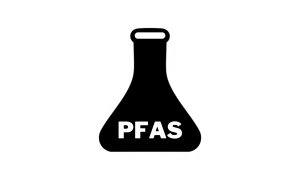
- The label must clearly inform the consumer that the product contains intentionally added PFAS. The label shall be an outline of an Erlenmeyer flask with the word “PFAS” inside the flask. The label must be clearly visible and legible prior to sale. The label must be displayed with such conspicuousness as compared with other words, statements, designs, or devices on the product as to render the label likely to be seen, read, and understood by an ordinary individual under customary conditions of purchase or use. Text shall be no smaller than the largest font used for other consumer information on the product.
- Labels affixed to products must be printed, mounted, molded, engraved, embossed, or otherwise affixed to the product.
- If the product is sold in consumer packaging that obscures the label on the product, then the consumer packaging must also be labeled. If, prior to sale, a retailer re-packages the labeled product, then the retailer shall label the new consumer packaging in accordance with this section.
- Where the consumer is unable to view the labels on the product or consumer packaging at the time of purchase or receipt, such as in catalog or online sales transactions that occur over the Internet or telephone, the manufacturer or retailer shall, prior to sale or distribution, clearly include information to the prospective consumer prior to purchase that the product contains intentionally added PFAS by providing a label or disclosure.
- The manufacturer shall apply any required product and package labels unless the wholesaler or retailer agrees in writing with the manufacturer to accept responsibility for such application.
The final rule defines a complex durable good as “a product that is a manufactured good composed of 100 or more manufactured components, with an intended useful life of five or more years, where the product is typically not consumed, destroyed, or discarded after a single use.” Under the final rule, prior to sale of a complex durable good that contains intentionally added PFAS, manufacturers must conform to the following information requirements:
- A label indicating the presence of intentionally added PFAS must be included in the consumer facing product specification sheet available to potential consumers prior to purchase. The label shall be an outline of an Erlenmeyer flask with the word “PFAS” inside the flask.
- The label must be easily identified and legible on the consumer facing product specification sheet. A ten-point font or larger is presumed to be legible.
- The consumer facing operation and maintenance manual associated with the complex durable good must include an outline of an Erlenmeyer flask with the word “PFAS” inside the flask, indicating the presence of intentionally added PFAS.
Manufacturers may comply with New Mexico’s labeling requirement by labeling all units, or, as applicable, consumer facing specification sheets and consumer facing operation and maintenance manuals of the product sold in New Mexico in compliance with corresponding requirements adopted by another state. Manufacturers doing so must provide NMED with a copy of the label as it will appear on products and consumer packaging in New Mexico and a narrative explaining how it fulfills the intent of New Mexico’s requirements.
NMED may waive the obligation of a manufacturer to label a product or product class if:
- The product is exempt from the reporting and prohibition requirements; and
- None of the product’s material containing intentionally added PFAS will ever come into direct contact with a consumer while the product is being used as intended during the useful life of the product.
Labeling waiver requests are due October 31, 2026. According to the final rule, waiver requests will be considered approved pending review, and NMED will issue a final determination of whether to approve or deny the request by June 1, 2027. If NMED denies the waiver request, a manufacturer must label a product for sale or distribution within 90 days of the label waiver denial; products that have already been manufactured up to the date of denial may be sold without a label. Approved label waiver requests will expire three years after approval.
Commentary
Certain aspects of New Mexico’s final rule are unsurprising. Several states, including Maine and Minnesota, have already banned intentionally added PFAS in the product categories subject to New Mexico’s 2027 and 2028 prohibitions. Maine and Minnesota will also prohibit intentionally added PFAS in most products in 2032 unless the products are exempt or have a CUU. We have reported often on Minnesota’s reporting rule, recently postponed to September 15, 2026. The bright spot in New Mexico’s final rule is that reports in New Mexico will be due after Minnesota. Reports in Minnesota will be publicly available, and the information required in New Mexico is arguably substantially equivalent to that in Minnesota. There is the question of how Minnesota and New Mexico define “intentionally added,” leading Minnesota not to require reporting on byproducts and impurities, while New Mexico does, but overall, it is a minor issue.
The key issue for manufacturers will be the labeling requirement. Presented during NMEIB’s administrative rulemaking as solely a statement of fact, requiring labeling on almost all products containing intentionally added PFAS manufactured after January 1, 2027, is a tall order. The label proposed by NMED in October 2025 included the statement “Caution: Associated with environmental impacts and health effects such as cancer.” While arguably true for perfluorooctanoic acid (PFOA) and perfluorooctane sulfonic acid (PFOS), those are only two substances among the thousands that make up the class of PFAS. This makes it hard to accept that the current labeling requirement is intended to be purely factual.
Between now and early 2027, manufacturers of products containing intentionally added PFAS face a number of deadlines at the state level:
- August 16, 2026 — Minnesota: Reporting extension and waiver requests must be postmarked.
- September 15, 2026 — Minnesota: Reports due. The Minnesota Pollution Control Agency (MPCA) will make the reports publicly available as it reviews them.
- October 31, 2026 — New Mexico: CUU proposals for prohibitions effective January 1, 2027. Complete requests will be considered approved pending review.
- October 31, 2026 — New Mexico: Label waiver requests are due. Complete requests will be considered approved pending review.
- December 14, 2026 — Minnesota: Reports from manufacturers that received extensions are due.
- January 1, 2027 — New Mexico: Reports due on products containing intentionally added PFAS.
- January 1, 2027 — New Mexico: Labels required for products manufactured after January 1, 2027.
- February 1, 2027 — Minnesota: Annual update to September 15, 2026, reports, and reports for new products are due.
Maine and New Mexico are not the only states with deadlines in the next several months. Connecticut has a labeling requirement taking effect July 1, 2026. One of the key differences between Connecticut’s requirement and New Mexico’s, however, is that Connecticut requires labeling only for apparel, carpets or rugs, cleaning products, cookware, cosmetic products, dental floss, fabric treatments, juvenile products, menstruation products, textile furnishings, ski wax, or upholstered furniture. There are already labeling or prohibition requirements for these products in several states. Connecticut will also require manufacturers of these products to notify it beginning July 1, 2026, if the products contain intentionally added PFAS. Connecticut has yet to provide details on how information related to the notification requirement can be submitted, but given that several states already prohibit PFAS in these categories, manufacturers have likely reformulated their products to remove intentionally added PFAS.
Manufacturers need to review New Mexico’s final rule and begin working immediately to determine whether a CUU proposal or label waiver request must be submitted. If a label waiver request is not possible, manufacturers will have to determine whether product labeling will suffice or if both the product and the consumer packaging must be labeled. Meanwhile, manufacturers will need to monitor for more information on whether reporting in Minnesota will meet New Mexico’s January 1, 2027, reporting requirement, or if more will be necessary.
It is enough to make your head explode.